


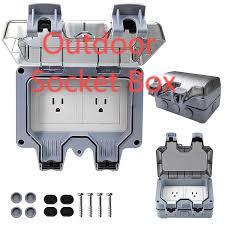
Outdoor power points must be chosen and placed with care, and a well-positioned Nante Outdoor Socket Box within a site plan protects equipment and users from weather and vandalism. In early design stages, installing a Nante Outdoor Socket Box where loads are needed reduces long cable runs, simplifies maintenance, and lowers the risk of moisture-related failures.
Assessing site exposure realistically
Begin with a site survey that documents real-world exposure — prevailing winds, splash zones, pressure-wash areas, and likely impact points from vehicles or tools. Don’t rely only on typical rainfall figures; wind-driven spray and seasonal storms often determine ingress risk. Note human factors too: vandalism likelihood, accessibility for servicing, and whether the unit will be within reach of the general public. Convert these observations into required protection levels (IP or NEMA ratings) and impact resistance (IK) to guide material and sealing choices.
Material selection and finish that extend life
Material choice drives lifecycle cost. Stainless steel (especially 316) and marine-grade alloys are best for corrosive or coastal atmospheres; powder-coated steel is economical for general industrial use if the coating system is properly specified. Fiber-reinforced plastics provide dielectric isolation and resistance to many chemicals, making them suitable for certain installations. Importantly, specify corrosion-resistant fasteners, gland plates, and internal rails — mixed-metal assemblies often fail at small parts long before the main body shows wear. For painted finishes, require documented coating thickness and adhesion testing to avoid early peeling.
Sealing, access design, and tamper resistance
Seals and covers are where protection succeeds or fails. Use continuous gaskets with proven compression characteristics and captive fasteners that prevent lost hardware. Design covers with drip lips and slopes so water sheds away from seams. For public or unsupervised locations, choose lockable covers, tamper-proof screws, and recessed mounting to minimize impact. If meter or indicator visibility is necessary, use lockable, UV-stable windows rather than opening the enclosure for routine checks. Properly specified cable glands and through-wall fittings preserve the intended ingress rating.
Electrical installation and wiring best practices
Installation detail preserves performance: size cable glands to the outer jacket, respect conductor bending radii, and use strain reliefs to prevent vibration from loosening terminals. Torque terminal screws to manufacturer specs and record those values at commissioning — loose terminations are a common cause of heating and failures. Separate power and communications circuits when possible and plan for future expansion with spare conduit knockouts or removable gland plates. When possible, prefer factory-configured harnesses to reduce field variability and maintain warranty coverage.
Thermal management and condensation control
Exterior enclosures face both solar heating and internal heat generated by protective devices. Reflective finishes, sun-shields, or strategic orientation reduce direct solar gain. For internal heat sources, consider filtered breather vents, thermostatic fans, or low-wattage heaters to manage condensation and prevent moisture cycling. Provide positive drainage paths and desiccant compartments where fully sealed designs would otherwise trap moisture. Thoughtful thermal planning reduces nuisance trips and preserves the life of internal components.
Maintenance planning and spare-part strategy
Routine, modest inspections extend service life greatly. Check gaskets and seals for compression set, inspect fasteners for corrosion, and test protective devices periodically. Maintain a small spares kit — gaskets, captive screws, common breakers, and gland fittings — so repairs are fast. Document the as-built wiring and take commissioning photos; these save hours during replacements or audits. Schedule more frequent checks in aggressive environments (coastal, chemical, or heavy washdown) and increase preventive measures accordingly.
Procurement checklist and specification tips
When procuring outdoor socket enclosures, require datasheets showing IP/IK ratings, material certificates, and third-party test evidence. Ask for CAD models to verify mounting and service clearances. Evaluate warranty terms, spare-part availability, and whether factory-configured options (pre-fitted glands, factory wiring) are available to reduce field work. Consider total cost of ownership: a robust enclosure with better seals and serviceability often costs less over its life than a cheaper unit that requires frequent repairs.
Selecting and installing exterior socket boxes is a systems exercise: align protection levels with documented site hazards, choose compatible materials, design for thermal and moisture control, and plan maintenance up front. These steps create reliable, low-maintenance exterior power points that keep equipment and people safe. For product specifications and model options, visit https://www.nante.com/product/

 English
 Arabic
 French
 Spanish
 Portuguese
 Deutsch
 Turkish
 Dutch
Dutch
 Russian
 Romaian
 Portuguese (Brazil)
 Greek
Greek