


Building a dependable writing team is one of the hardest parts of running an academic support business. Almost every application looks polished on the surface, but only a small share of candidates have the mix of skill, depth, and consistency that students depend on. When the wrong person slips through, the entire workflow suffers — deadlines become harder to meet, quality checks pile up, and clients lose trust.
This is why a clear hiring system matters. A good process protects standards, avoids guesswork, and gives new writers room to prove their strengths before they take on real responsibility. Over the years, I’ve refined a structure that helps filter out weak applicants early and highlight the ones who can grow into reliable long-term team members.
Below is a look at how that process works and why each stage matters.
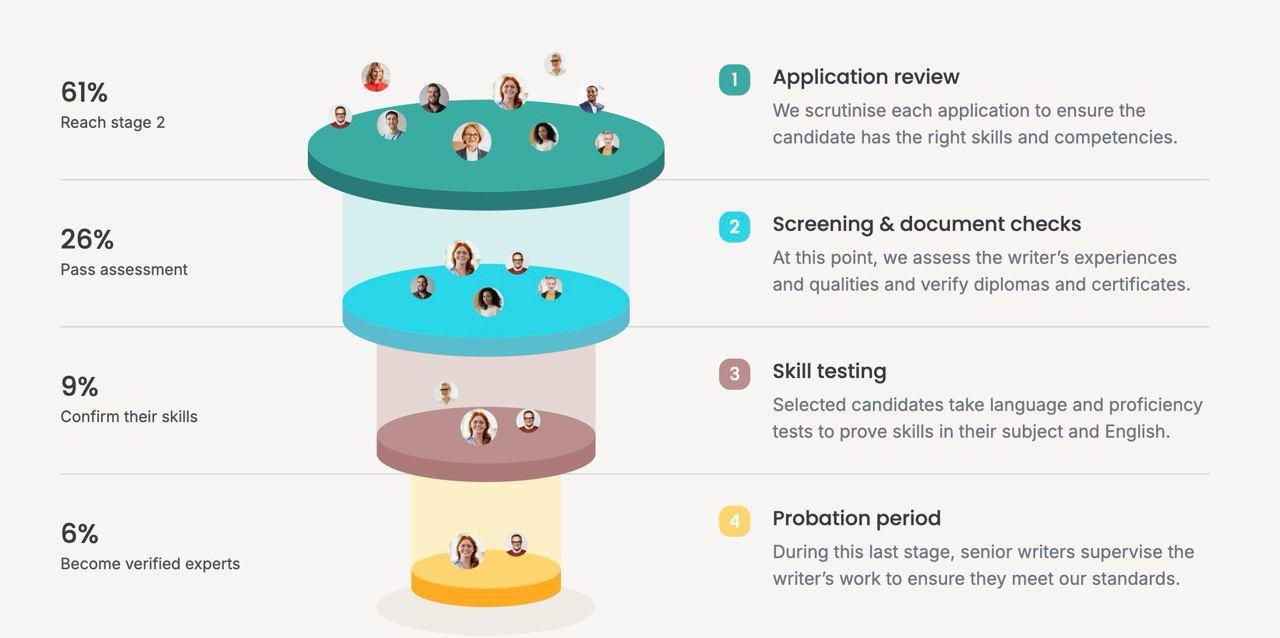
Application Review: The First Filter That Saves Time and Protects Standards
The earliest stage may seem simple, but it sets the tone for everything that follows. When a candidate sends an application, I’m not just looking at their résumé or list of degrees. I’m paying attention to how they present themselves, how they explain their experience, and whether they show proof of actual writing ability.
Most people can claim they “love writing” or are “good with research.” Claims alone mean nothing. A strong application shows clear thinking, steady grammar, and a sense of responsibility. The way an applicant writes about their own work usually tells me more than any list of achievements.
At this stage, many applications are filtered out. And that’s a good thing — it protects the next steps from being overwhelmed with people who are simply not ready. A writing team can maintain quality only when its members have real skill from the start.
Screening and Document Checks: Making Sure Credentials Are Real
After the first review, the next step is verifying everything the candidate claims. Degrees, certificates, job history — all of it needs to be checked. This isn’t about distrust. It’s about building a team where every member has proven training behind their work.
Students rely on writers who understand their field, whether it’s nursing, psychology, business, or law. If someone claims to be an expert in a subject but cannot prove it, they can’t be trusted with tasks that shape a student’s grade.
Document checks also reveal how serious the applicant is. Strong candidates send clear copies, respond quickly, and never hesitate to provide proof. Weak ones delay, avoid questions, or send files that don’t match their statements. Those are red flags, and they matter.
This stage keeps the team honest. It ensures that when a client works with an expert, they truly are dealing with someone trained for the task — someone like the OzeEssay writers who carry both subject knowledge and proven writing ability.
Skill Testing: Checking Real Ability Through Practical Tasks
Every writer who passes the document check moves on to a set of skill tests. This is the part that reveals the applicant’s true ability. It’s easy to list skills on paper; it’s much harder to show them under real conditions.
The tests cover two areas:
Language and Writing Skills
The candidate must show they can write clear, natural English. Not stiff. Not shallow. Real writing. I look for rhythm, logic, and the ability to explain ideas without sounding mechanical or vague. A person might have advanced degrees but still struggle with basic clarity. The test catches that right away.
Subject-Specific Knowledge
This is where the applicant proves they understand the field they claim to be trained in. For example, a nursing writer should know how to structure evidence-based work, cite sources correctly, and handle case scenarios. A business writer should know how to build arguments, compare models, and apply theory.
The goal isn’t perfection. The goal is to see whether the applicant can produce accurate work independently. Once they pass this stage, they move on to the most important part of the process: probation.
Probation and Supervision: Where Real Growth Happens
Probation is the stage that makes or breaks a new hire. It’s the part where I see how the writer handles real orders, follows instructions, and responds to feedback. This stage usually lasts long enough to reveal patterns — good and bad.
During probation, senior writers supervise the new member’s tasks. They check tone, structure, accuracy, and the writer’s ability to stay calm under pressure. Even the strongest applicants make mistakes early on, but what matters is how they respond. Do they accept guidance? Do they repeat the same error? Do they adjust quickly?
A good writer improves at a steady pace. They show consistency, and they treat every project with care. By the time they finish probation, their work becomes predictable in the best way — reliable, accurate, and easy to trust.
Writers who cannot meet these standards don’t move forward. It’s not personal; it’s necessary. A writing team is only as strong as its weakest member, and probation ensures the wrong people don’t make it through.
Why This System Matters for the Entire Team
A structured hiring process does more than filter out weak applicants. It protects the writers who are already part of the team. When everyone goes through the same steps — review, checks, testing, probation — no one can claim the standards are unfair or unclear.
This also creates a culture where writers know they are surrounded by skilled peers. That sense of balance improves teamwork, keeps communication strong, and reduces conflict. Writers feel safer sharing tips, asking questions, and supporting each other because they know everyone else earned their place the same way.
From a business owner’s perspective, this stability is priceless. It cuts down on turnover, boosts client trust, and makes long-term planning easier.
Conclusion: A Strong Team Doesn’t Happen By Accident
Reliable writing teams aren’t built through luck. They’re built through a process that respects skill, checks credentials, and gives new writers the chance to prove themselves before taking on full responsibility.
Each step — application review, document checks, testing, and probation — plays a role in shaping a team that students can trust. And when that foundation is strong, everything else becomes easier: quality stays high, deadlines stay manageable, and clients return because they know they’re in capable hands.

 Arabic
 French
 Spanish
 Portuguese
 Deutsch
 Turkish
 Dutch
Dutch
 Italiano
 Russian
 Romaian
 Portuguese (Brazil)
 Greek
Greek